

The dark web has inspired some of the internet’s most disturbing stories. Secret human trafficking auctions, horrifying experiments involving human beings, and websites where anyone could supposedly hire a professional killer with Bitcoin.
Some of these stories sound like something straight out of a horror movie. Others have circulated for years across anonymous forums, YouTube videos, and online communities.
But here’s the interesting part: some of these legends have connections to real crimes, even when their most sensational claims turn out to be false. And that’s where things get complicated.
Before diving in, it’s worth clearing up a common misconception. The deep web and the dark web are not the same thing. The deep web includes ordinary content that search engines don’t index, while the dark web refers to networks and websites that require specialized software, such as Tor, to access.
Now, let’s explore three of the most infamous dark web urban legends and separate documented facts from internet fiction.
1. Black Death: The Dark Web Human Trafficking Legend
Imagine discovering a hidden website claiming to auction kidnapped women to the highest bidder.
That’s the disturbing premise behind Black Death, one of the most notorious legends associated with the dark web.
The name became widely known through stories about an alleged criminal organization that supposedly kidnapped women and sold them through secret online auctions.
In July 2015, journalist Joseph Cox investigated one such website for VICE Motherboard. One listing advertised a woman identified as Nicole, with a starting price of $150,000.
The website presented disturbing photographs and claimed that interested buyers could participate in an auction.
There was just one problem. The evidence didn’t add up.
Following publication, readers identified footage suggesting that the photographs had been taken from an adult video rather than documenting an actual trafficking victim.
The supposed auction appeared to be a scam designed to exploit people willing to pay for criminal services. But the Black Death story didn’t disappear.
The Chloe Ayling Kidnapping Case
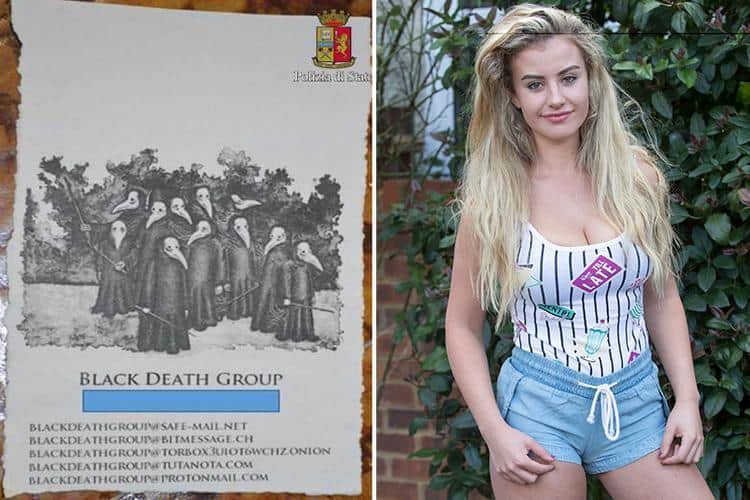
In July 2017, British model Chloe Ayling traveled to Milan for what she believed was a professional photo shoot Instead, she was drugged, kidnapped, and held captive for six days.
Her captor, Lukasz Herba, claimed to be associated with a criminal organization called Black Death. He threatened to sell her through an online auction unless a ransom was paid.
The case attracted international attention, partly because it seemed to resemble the dark web trafficking stories that had circulated for years.
In June 2018, an Italian court sentenced Herba to 16 years and nine months in prison for the kidnapping.
As ABC News reported, the kidnapping was real, but that did not establish the existence of the alleged trafficking organization.
In fact, evidence presented during the investigation undermined Herba’s claims about Black Death. So what’s the verdict?
The kidnapping was real. The supposed international dark web auction network was not substantiated.
And that’s an important distinction. A real crime can become entangled with an internet legend without proving that the legend itself is true.
2. Human Dolls: The Horrifying Legend That Spread Across the Internet

Some dark web stories are disturbing because they describe actual crimes. Others are disturbing because someone imagined them in the first place.
The Human Dolls legend, also known as Lolita Slave Toys, belongs to the second category.
According to the story, a mysterious website supposedly advertised human beings who had undergone horrific surgical procedures to transform them into living dolls.
The alleged victims were described as being unable to move or communicate, with prices supposedly reaching hundreds of thousands of dollars.
The story spread through anonymous internet forums, screenshots, and discussions associated with communities such as 4chan.
Some versions claimed that the operation originated from a disturbing online forum called Violent Desires.
Others suggested that an unidentified surgeon was responsible for the supposed procedures.
But despite the shocking descriptions, no credible evidence has established that such a commercial operation existed.
How a Horror Story Became a Dark Web Myth
The Human Dolls legend illustrates how easily fictional horror can be presented as a hidden internet discovery.
A disturbing story appears on an anonymous forum. Someone creates a screenshot. Another person shares it without context.
Eventually, thousands of people encounter the same claim, often without knowing where it originated.
The supposed evidence becomes part of the story itself.
And because the dark web is frequently portrayed as an anonymous place beyond ordinary scrutiny, the absence of verifiable information can make the legend seem more mysterious rather than less credible.
In reality, the claims associated with Human Dolls remain unsupported.
The Brazilian publication Superinteressante has also examined the legend, identifying it as an internet hoax rather than a documented criminal enterprise.
That doesn’t make the subject any less disturbing. It simply means that a horrifying story should not be mistaken for evidence.
The verdict: Human Dolls is an internet horror legend, with no credible evidence supporting its central claims.
3. Dark Web Hitmen: The Besa Mafia Scam

What if you could hire a professional assassin as easily as ordering something online?
That was the promise made by several websites claiming to offer murder-for-hire services through the dark web. Among the most infamous was Besa Mafia.
The website presented itself as a marketplace where customers could supposedly hire professional killers or hackers.
Payments were requested in Bitcoin, and the platform claimed to operate through an anonymous criminal network.
For anyone familiar with dark web mythology, it sounded almost too predictable.
A hidden website, cryptocurrency payments, anonymous administrators, and promises of services that would be impossible to advertise openly. But Besa Mafia became particularly notorious when its operation was exposed.
The Researcher Who Uncovered the Scam
Cybersecurity researcher Chris Monteiro investigated Besa Mafia and discovered that the website was not what it claimed to be.
Rather than operating a genuine assassination service, the administrators appeared to be collecting payments from people who believed they were hiring killers.
Monteiro and other researchers obtained access to communications associated with the website, revealing details of its operation.
A detailed WIRED investigation documented how the scam operated and how the information uncovered eventually became connected to real criminal investigations.
And here’s where the story takes an unexpected turn.
Although the website was fraudulent, some of its customers genuinely wanted other people killed.
A Fake Hitman Website, but Real Criminal Intent
One particularly revealing case involved Kristy Lynn Felkins, a Nevada woman who attempted to arrange the murder of her former husband.
According to the U.S. Department of Justice, Felkins sent approximately $5,000 worth of Bitcoin to Besa Mafia in 2016.
She also communicated with the website’s administrator and provided information about her intended target.
The website, however, was a scam. No assassin was dispatched through the service, and Felkins lost the cryptocurrency she had paid.
That didn’t make her actions harmless. In July 2023, she was sentenced to five years in federal prison for her role in the murder-for-hire plot.
This is what makes the Besa Mafia story different from many other dark web legends.
The advertised assassination service was fraudulent, but the intentions of some customers were very real.
Other websites using names such as Sicilian Hitmen and Camorra Hitmen also circulated online, often with similar promises and presentation styles. Their claims should not be treated as proof that genuine assassination networks operated behind them.
The verdict: Besa Mafia was a scam, but the criminal intentions of some people who used it were genuine.
Why Do Dark Web Legends Continue to Fascinate People?
There’s something about the unknown that makes a story difficult to ignore. The dark web provides an almost perfect setting for internet folklore because it combines real anonymity technologies, documented criminal marketplaces, and a general lack of public understanding.
That combination creates room for exaggeration. A fraudulent website becomes a secret criminal organization. A fictional horror story becomes an alleged underground business. And an online scam becomes part of a real murder investigation.
The problem is that these stories often circulate without the context needed to distinguish reality from invention.
Human trafficking is a real crime. Murder-for-hire plots are real. Cybercriminals do exploit anonymity technologies.
But none of those facts automatically validates every sensational claim made about the dark web.
Sometimes, the truth is less cinematic than the legend. And sometimes, as the Besa Mafia case demonstrates, the truth is disturbing for entirely different reasons.
The Real Mystery Behind the Dark Web
Black Death, Human Dolls, and Besa Mafia became famous for different reasons.
One legend became associated with a genuine kidnapping. Another spread through disturbing internet folklore. And the third exposed how a fraudulent website could attract people willing to commit serious crimes.
Their stories reveal something about the internet itself.
Anonymity can protect legitimate users, including journalists, researchers, and people living under censorship. But it can also provide an environment where scams, misinformation, and criminal activity become harder to investigate.
The dark web isn’t a supernatural place where every horrifying rumor is true. It’s part of the internet, shaped by many of the same human behaviors found elsewhere. And perhaps that’s the most unsettling conclusion.
Sometimes, the scariest thing about the dark web isn’t what people claim exists there. It’s what real people are willing to believe, pay for, or attempt.

